 homebuildy.com
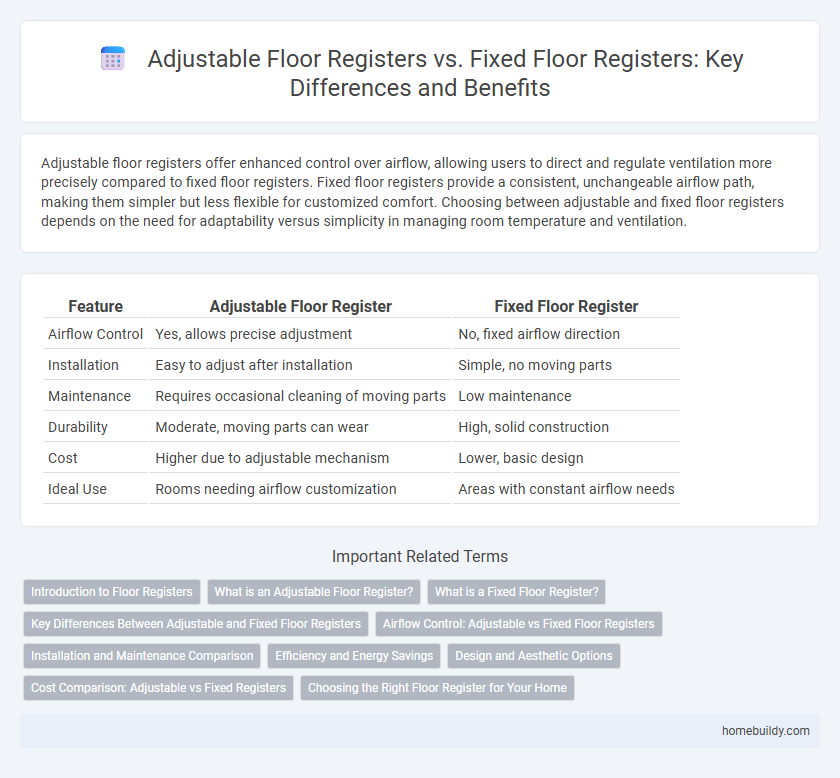
 Adjustable floor registers offer enhanced control over airflow, allowing users to direct and regulate ventilation more precisely compared to fixed floor registers. Fixed floor registers provide a consistent, unchangeable airflow path, making them simpler but less flexible for customized comfort. Choosing between adjustable and fixed floor registers depends on the need for adaptability versus simplicity in managing room temperature and ventilation.
Table of Comparison
| Feature | Adjustable Floor Register | Fixed Floor Register |
|---|---|---|
| Airflow Control | Yes, allows precise adjustment | No, fixed airflow direction |
| Installation | Easy to adjust after installation | Simple, no moving parts |
| Maintenance | Requires occasional cleaning of moving parts | Low maintenance |
| Durability | Moderate, moving parts can wear | High, solid construction |
| Cost | Higher due to adjustable mechanism | Lower, basic design |
| Ideal Use | Rooms needing airflow customization | Areas with constant airflow needs |
Introduction to Floor Registers
Floor registers are essential components in HVAC systems, facilitating efficient airflow regulation within indoor spaces. Adjustable floor registers offer customizable control over airflow direction and volume, enhancing comfort and energy efficiency compared to fixed floor registers, which provide a constant, unchangeable flow. Selecting the appropriate type depends on specific ventilation needs and room layout, impacting overall climate control and system performance.
What is an Adjustable Floor Register?
An adjustable floor register features movable louvers or vents that allow users to control airflow direction and volume, enhancing indoor air quality and comfort. Unlike fixed floor registers with static grills, adjustable models provide flexibility for heating and cooling systems, optimizing temperature regulation in different rooms. These registers are commonly used in HVAC systems to improve energy efficiency and customize air distribution based on user preference.
What is a Fixed Floor Register?
A fixed floor register is a ventilation cover installed directly over duct openings in the floor, designed without adjustable louvers or dampers to control airflow. It provides a consistent and unchangeable air distribution, ensuring stable ventilation throughout the room. Fixed floor registers are commonly used in HVAC systems where airflow regulation is unnecessary or managed elsewhere.
Key Differences Between Adjustable and Fixed Floor Registers
Adjustable floor registers allow users to control airflow by opening or closing the vent slats, providing customized ventilation and enhanced comfort in different rooms. Fixed floor registers have a set vent size and position, resulting in consistent airflow but limited control over ventilation levels. The choice between adjustable and fixed floor registers impacts energy efficiency and room temperature regulation by either allowing airflow modulation or maintaining a steady flow.
Airflow Control: Adjustable vs Fixed Floor Registers
Adjustable floor registers enable precise airflow control by allowing users to open or close the vents to regulate air distribution effectively. Fixed floor registers lack this flexibility, providing a constant airflow that cannot be altered to meet specific heating or cooling needs. Choosing adjustable registers enhances energy efficiency and comfort by tailoring airflow to individual room requirements.
Installation and Maintenance Comparison
Adjustable floor registers offer versatile installation options due to their movable louvers, allowing precise airflow control and reducing the need for frequent adjustments after setup. Fixed floor registers have a simpler installation process but limit airflow regulation, often requiring replacement or supplemental components for maintenance. Maintenance for adjustable registers is generally easier as their parts can be cleaned or replaced without removing the entire unit, whereas fixed registers may necessitate more extensive disassembly.
Efficiency and Energy Savings
Adjustable floor registers enhance airflow control, allowing precise regulation of heating and cooling, which improves overall HVAC efficiency and reduces energy waste. Fixed floor registers lack this flexibility, often leading to uneven temperature distribution and higher energy consumption as systems work harder to compensate. Investing in adjustable floor registers contributes to significant energy savings by optimizing air distribution and maintaining a consistent indoor climate.
Design and Aesthetic Options
Adjustable floor registers offer versatile design options with movable grilles that allow control over airflow direction, enhancing both functionality and aesthetic appeal in various room styles. Fixed floor registers feature a simpler, more streamlined design ideal for consistent airflow without the need for adjustment, often available in a variety of materials and finishes to complement interior decor. Choosing between adjustable and fixed registers depends on the desired balance between customization of air distribution and cohesive visual integration within the space.
Cost Comparison: Adjustable vs Fixed Registers
Adjustable floor registers typically cost more upfront than fixed registers due to their customizable airflow control features, ranging from $20 to $50 per unit compared to $10 to $20 for fixed registers. While adjustable registers may reduce HVAC energy expenses by optimizing air distribution, their initial price can be offset over time through improved efficiency and comfort. Fixed floor registers are a budget-friendly option for standard ventilation needs but lack the flexibility to fine-tune airflow, potentially leading to higher energy usage.
Choosing the Right Floor Register for Your Home
Adjustable floor registers offer customizable airflow control, allowing homeowners to regulate room temperature and improve energy efficiency more effectively than fixed floor registers. Fixed registers provide a simple, cost-effective solution with predetermined openings, best suited for areas where airflow does not require frequent adjustment. Evaluating room usage, HVAC system compatibility, and comfort preferences helps determine the optimal floor register type for residential spaces.
adjustable floor register vs fixed floor register Infographic