 homebuildy.com
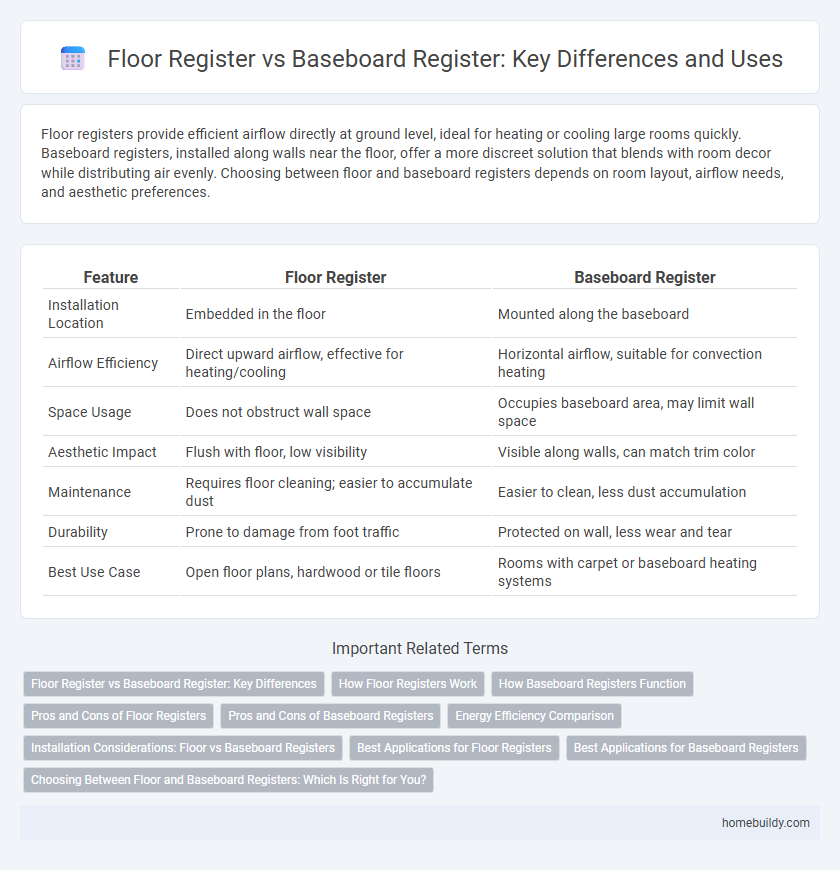
 Floor registers provide efficient airflow directly at ground level, ideal for heating or cooling large rooms quickly. Baseboard registers, installed along walls near the floor, offer a more discreet solution that blends with room decor while distributing air evenly. Choosing between floor and baseboard registers depends on room layout, airflow needs, and aesthetic preferences.
Table of Comparison
| Feature | Floor Register | Baseboard Register |
|---|---|---|
| Installation Location | Embedded in the floor | Mounted along the baseboard |
| Airflow Efficiency | Direct upward airflow, effective for heating/cooling | Horizontal airflow, suitable for convection heating |
| Space Usage | Does not obstruct wall space | Occupies baseboard area, may limit wall space |
| Aesthetic Impact | Flush with floor, low visibility | Visible along walls, can match trim color |
| Maintenance | Requires floor cleaning; easier to accumulate dust | Easier to clean, less dust accumulation |
| Durability | Prone to damage from foot traffic | Protected on wall, less wear and tear |
| Best Use Case | Open floor plans, hardwood or tile floors | Rooms with carpet or baseboard heating systems |
Floor Register vs Baseboard Register: Key Differences
Floor registers are installed flush with the floor surface, allowing airflow to be directed vertically, making them ideal for rooms with limited wall space. Baseboard registers are mounted along the baseboard, releasing air horizontally, which can enhance heat distribution in rooms with lower window areas. The primary differences include placement, airflow direction, and suitability for specific room layouts and heating systems.
How Floor Registers Work
Floor registers control airflow by covering duct openings in the floor and directing warm or cool air into the room through adjustable vents or louvers. They utilize gravity and air pressure differences to distribute conditioned air efficiently, allowing users to regulate temperature and airflow intensity. Unlike baseboard registers, floor registers are installed flush with the floor surface, minimizing obstruction and optimizing air circulation in central heating and cooling systems.
How Baseboard Registers Function
Baseboard registers function by allowing warm air from the heating system to flow through the narrow slots along the baseboard, promoting efficient heat distribution at the room's perimeter. Unlike floor registers that direct airflow upward from the floor, baseboard registers provide consistent, gentle convection heating by warming the air at a lower level, which then rises naturally. This design helps maintain an even temperature throughout the room while maximizing wall space and reducing obstruction risks.
Pros and Cons of Floor Registers
Floor registers offer efficient airflow control and blend seamlessly with hardwood or tile flooring, enhancing room aesthetics while allowing warm air to rise naturally. However, they can accumulate dust and debris more easily due to their location and may require frequent cleaning to maintain optimal performance. Unlike baseboard registers, floor registers can be prone to damage from foot traffic or furniture placement, potentially reducing durability.
Pros and Cons of Baseboard Registers
Baseboard registers offer a discreet heating solution that combines functionality with aesthetic appeal, seamlessly integrating into room decor by running along the floor's perimeter. They provide consistent heat distribution at lower heights, ideal for warming cooler air near the floor, but their placement can limit furniture arrangement and may accumulate dust and debris more easily compared to floor registers. Maintenance can be more challenging since baseboard registers often require removal for cleaning or repair, while floor registers generally allow easier access.
Energy Efficiency Comparison
Floor registers typically offer superior energy efficiency compared to baseboard registers by promoting better air circulation through direct heat distribution across the room. Floor registers reduce heat loss by minimizing obstruction and allowing warm air to rise naturally, enhancing overall heating system performance. In contrast, baseboard registers often result in uneven heating and increased energy consumption due to their lower position and limited airflow movement.
Installation Considerations: Floor vs Baseboard Registers
Floor registers require installation directly into the floor surface, demanding precise cutting and fitting for airflow optimization and stability, whereas baseboard registers are mounted along the wall base, often simplifying installation by utilizing existing wall cavity spaces. Floor register installation may require reinforcement around the duct opening to support foot traffic and prevent damage, while baseboard registers typically need secure attachment to wall framing and careful sealing to prevent air leaks. Choosing between the two involves evaluating floor material, room layout, and ease of maintenance, as floor registers are prone to debris accumulation, whereas baseboard registers may offer easier access for cleaning and adjustments.
Best Applications for Floor Registers
Floor registers excel in distributing warm air evenly across large open spaces and hardwood or tile flooring, making them ideal for living rooms and kitchens. Their low-profile design allows for unobstructed airflow and easy integration into carpeted floors without causing damage. Floor registers are best suited for rooms requiring efficient air circulation without compromising aesthetic or furniture placement.
Best Applications for Baseboard Registers
Baseboard registers are best applied in rooms with limited floor space, such as narrow corridors or small bedrooms, where floor registers may obstruct movement or furniture placement. They excel in heating efficiency for homes with baseboard heating systems, providing even heat distribution along walls without interrupting floor plans. Ideal for retrofitting older buildings, baseboard registers integrate seamlessly with existing wall ducts, minimizing installation complexity and enhancing aesthetic appeal.
Choosing Between Floor and Baseboard Registers: Which Is Right for You?
Floor registers effectively distribute warm air directly into living spaces, making them ideal for rooms with low foot traffic or where heating efficiency is a priority. Baseboard registers offer a sleek design that fits along walls, maximizing floor space and providing consistent heat circulation without obstructing furniture placement. Selecting between floor and baseboard registers depends on room layout, heating needs, and aesthetic preferences, ensuring optimal comfort and functionality.
Floor register vs baseboard register Infographic