 homebuildy.com
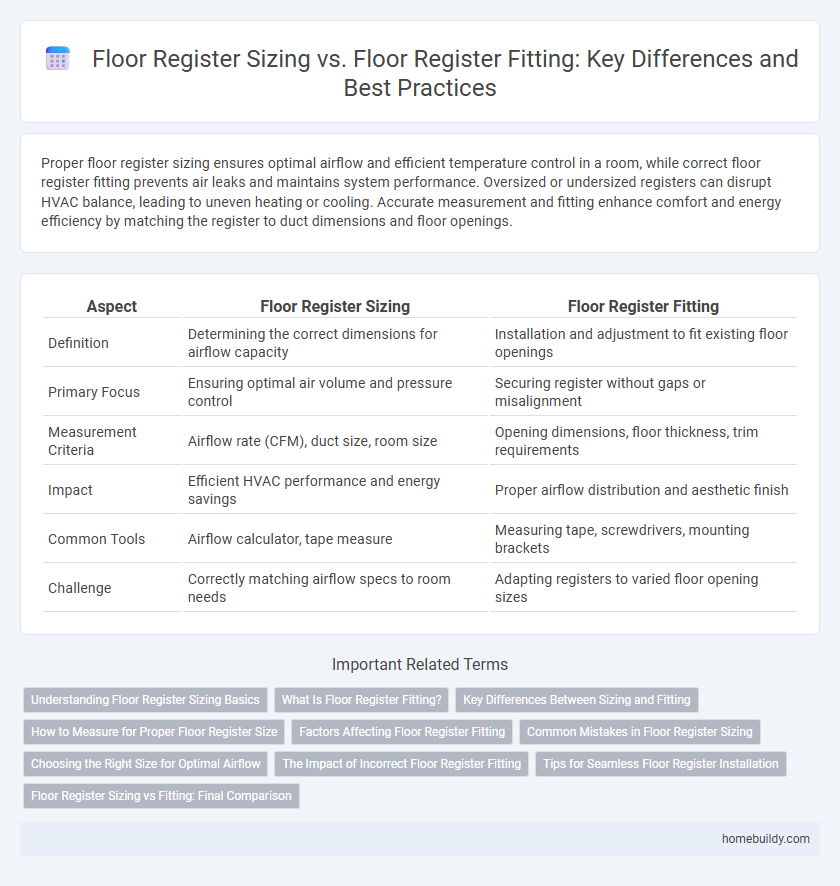
 Proper floor register sizing ensures optimal airflow and efficient temperature control in a room, while correct floor register fitting prevents air leaks and maintains system performance. Oversized or undersized registers can disrupt HVAC balance, leading to uneven heating or cooling. Accurate measurement and fitting enhance comfort and energy efficiency by matching the register to duct dimensions and floor openings.
Table of Comparison
| Aspect | Floor Register Sizing | Floor Register Fitting |
|---|---|---|
| Definition | Determining the correct dimensions for airflow capacity | Installation and adjustment to fit existing floor openings |
| Primary Focus | Ensuring optimal air volume and pressure control | Securing register without gaps or misalignment |
| Measurement Criteria | Airflow rate (CFM), duct size, room size | Opening dimensions, floor thickness, trim requirements |
| Impact | Efficient HVAC performance and energy savings | Proper airflow distribution and aesthetic finish |
| Common Tools | Airflow calculator, tape measure | Measuring tape, screwdrivers, mounting brackets |
| Challenge | Correctly matching airflow specs to room needs | Adapting registers to varied floor opening sizes |
Understanding Floor Register Sizing Basics
Accurate floor register sizing is crucial to ensure optimal airflow and efficient heating and cooling performance, directly affecting room comfort levels. Selecting the correct floor register size involves matching the duct opening dimensions and considering the required airflow volume measured in CFM (cubic feet per minute). Proper fitting prevents air leaks and noise, while oversized or undersized registers can lead to uneven temperature distribution and increased energy consumption.
What Is Floor Register Fitting?
Floor register fitting refers to the precise measurement and installation process that ensures the register perfectly matches the size of the floor opening, allowing optimal airflow and preventing air leakage. Proper fitting involves customizing the register dimensions to accommodate variations in floor joist spacing and subfloor thickness, which directly impacts HVAC system efficiency. Incorrect sizing can lead to reduced heating or cooling performance, making accurate floor register fitting essential for maintaining consistent indoor climate control.
Key Differences Between Sizing and Fitting
Floor register sizing determines the appropriate dimensions to ensure optimal airflow and fit within the ductwork, while floor register fitting focuses on the installation process and securing the register into the floor opening. Proper sizing avoids airflow restrictions and enhances HVAC efficiency, whereas correct fitting prevents air leaks and maintains the aesthetic alignment with flooring. Understanding these distinctions is crucial for maximizing system performance and durability.
How to Measure for Proper Floor Register Size
Accurate floor register sizing depends on measuring the duct opening rather than the existing register face to ensure proper airflow and fit. Use a tape measure to record the exact length and width of the duct, typically measuring the inside edges of the duct collar for rectangular or square openings. Choosing a floor register that matches these dimensions prevents air leakage and maintains HVAC system efficiency.
Factors Affecting Floor Register Fitting
Floor register fitting is influenced by factors such as duct size, floor material thickness, and airflow requirements, which determine the optimal register dimensions. Accurate floor register sizing ensures proper airflow distribution and prevents gaps that can lead to energy loss or debris infiltration. Additionally, variations in subfloor elevation and trim clearance impact the seamless integration and secure placement of the floor register.
Common Mistakes in Floor Register Sizing
Incorrect floor register sizing often leads to poor airflow distribution and inefficient heating or cooling, causing discomfort in the room. Common mistakes include choosing registers that are too small for the duct opening, resulting in increased air velocity and noise, or selecting oversized registers that reduce system pressure and performance. Proper measurement of duct dimensions and matching register size to airflow requirements ensure optimal fit and function, preventing these typical sizing errors.
Choosing the Right Size for Optimal Airflow
Selecting the correct floor register sizing ensures efficient airflow distribution and prevents pressure imbalances in HVAC systems. A properly sized floor register matches the ductwork dimensions and airflow requirements, optimizing comfort and energy efficiency. Avoiding oversized or undersized registers reduces noise, drafts, and unnecessary strain on heating or cooling equipment.
The Impact of Incorrect Floor Register Fitting
Incorrect floor register fitting can significantly reduce airflow efficiency, leading to uneven room temperature and increased energy costs. Improperly sized registers may cause pressure imbalances, resulting in noisy ducts and potential damage to HVAC components. Ensuring the correct sizing and fitting of floor registers is essential for optimal system performance and enhanced indoor comfort.
Tips for Seamless Floor Register Installation
Accurate floor register sizing ensures optimal airflow and prevents gaps that disrupt aesthetics and function. Measuring the duct opening precisely and selecting a register with matching dimensions guarantees a flush fit. Using shims or adjustable frames can help achieve seamless installation, enhancing both efficiency and visual appeal.
Floor Register Sizing vs Fitting: Final Comparison
Floor register sizing ensures optimal airflow by matching the duct size, while proper fitting guarantees a secure installation and prevents air leaks. Incorrect sizing can cause reduced efficiency and uneven temperature distribution, whereas poor fitting leads to draft issues and potential damage. Prioritizing accurate floor register sizing and precise fitting maximizes HVAC system performance and comfort.
Floor register sizing vs floor register fitting Infographic