 homebuildy.com
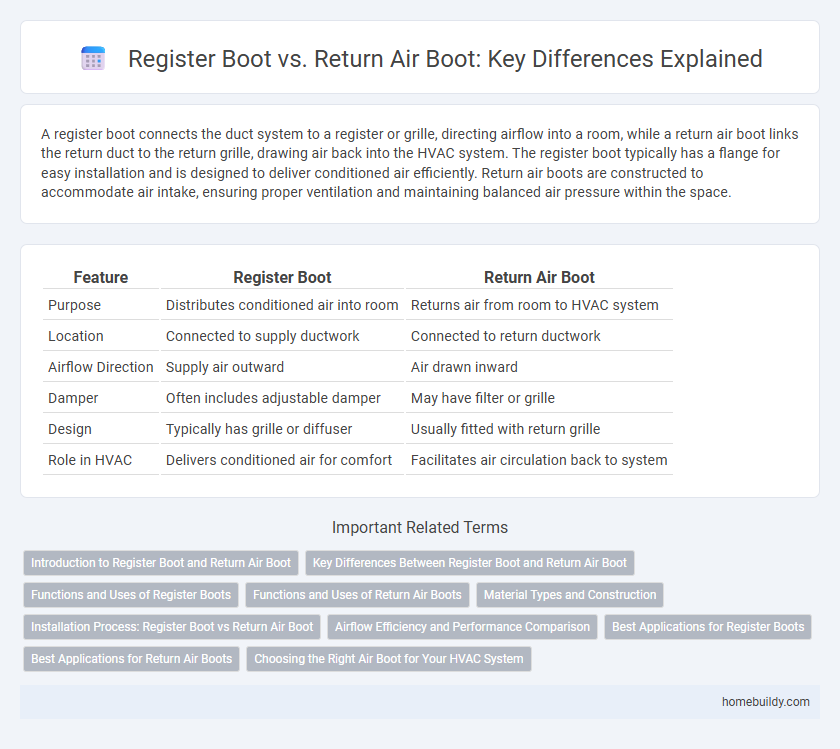
 A register boot connects the duct system to a register or grille, directing airflow into a room, while a return air boot links the return duct to the return grille, drawing air back into the HVAC system. The register boot typically has a flange for easy installation and is designed to deliver conditioned air efficiently. Return air boots are constructed to accommodate air intake, ensuring proper ventilation and maintaining balanced air pressure within the space.
Table of Comparison
| Feature | Register Boot | Return Air Boot |
|---|---|---|
| Purpose | Distributes conditioned air into room | Returns air from room to HVAC system |
| Location | Connected to supply ductwork | Connected to return ductwork |
| Airflow Direction | Supply air outward | Air drawn inward |
| Damper | Often includes adjustable damper | May have filter or grille |
| Design | Typically has grille or diffuser | Usually fitted with return grille |
| Role in HVAC | Delivers conditioned air for comfort | Facilitates air circulation back to system |
Introduction to Register Boot and Return Air Boot
Register boots connect supply air ducts directly to floor, wall, or ceiling registers, ensuring efficient airflow distribution and controllable ventilation at specific rooms or zones. Return air boots serve as the interface between return air ducts and grilles, facilitating the collection of used air back to the HVAC system for reconditioning. Both components play crucial roles in maintaining balanced airflow, indoor air quality, and overall HVAC system performance.
Key Differences Between Register Boot and Return Air Boot
Register boots are designed to deliver conditioned air directly into living spaces, featuring adjustable dampers for airflow control, whereas return air boots primarily draw air from rooms back to the HVAC system for filtration and reconditioning. Register boots typically connect to supply ducts and include grilles or registers, while return air boots attach to return ducts and usually lack adjustable vents. The key difference lies in their function: register boots distribute supply air, and return air boots facilitate air return, impacting system efficiency and indoor air quality.
Functions and Uses of Register Boots
Register boots serve as the primary interface between the HVAC duct system and interior spaces, directing conditioned air from supply registers efficiently into rooms. They facilitate airflow control and distribution by housing adjustable grilles or dampers to regulate air volume and direction. Unlike return air boots, which channel stale air back to the HVAC unit, register boots primarily manage the delivery of fresh, conditioned air to maintain comfort and indoor air quality.
Functions and Uses of Return Air Boots
Return air boots are designed to connect return air ducts to the air handler or plenum, ensuring efficient airflow back to the HVAC system for proper circulation and filtration. Unlike register boots, which deliver conditioned air into rooms, return air boots primarily function to collect and channel stale or warm air from interior spaces. Their use is critical in maintaining balanced air pressure and improving indoor air quality by enabling effective return air pathways.
Material Types and Construction
Register boots are typically constructed from galvanized steel or aluminum for durability and corrosion resistance, incorporating insulated cores to enhance thermal efficiency. Return air boots often use similar metal materials but prioritize larger surface areas and reinforced seams to handle higher airflow volumes and reduce leakage. Both types may include flexible duct connectors made from reinforced fabric or polymer to accommodate building movement and reduce vibration transmission.
Installation Process: Register Boot vs Return Air Boot
Register boots are typically installed directly in supply air ducts to connect registers, ensuring precise airflow distribution to rooms, while return air boots attach to return ducts to facilitate efficient air retrieval from spaces. Installation of register boots often requires sealing and fastening within the ceiling or wall openings, optimizing airflow control, whereas return air boots focus on creating airtight connections to prevent air leakage and maintain system pressure balance. Proper installation techniques for both involve ensuring correct fitment with ductwork and leveraging insulating materials to enhance HVAC system efficiency.
Airflow Efficiency and Performance Comparison
Register boots deliver targeted airflow directly to room vents, enhancing airflow efficiency by minimizing duct resistance and reducing energy loss. Return air boots, designed to collect air from larger areas, often experience higher pressure drops that can decrease overall system performance. Optimizing register boot design improves ventilation effectiveness and reduces HVAC system energy consumption.
Best Applications for Register Boots
Register boots are ideal for delivering conditioned air directly into living spaces, providing precise airflow control through adjustable grills, making them perfect for rooms requiring targeted ventilation. They work best in residential and light commercial settings where aesthetics and airflow customization are priorities. Unlike return air boots, which facilitate air extraction, register boots optimize air distribution and comfort within occupied zones.
Best Applications for Return Air Boots
Return air boots are best suited for HVAC systems requiring efficient air circulation through return ducts, ensuring balanced airflow and pressure throughout the building. They optimize filtration and reduce noise by connecting return air grilles directly to ductwork, making them ideal for residential and commercial spaces with closed ceiling systems. Unlike register boots, which distribute conditioned air, return air boots primarily manage air intake for effective system performance and indoor air quality.
Choosing the Right Air Boot for Your HVAC System
Selecting the right air boot for your HVAC system depends on factors such as airflow requirements, installation location, and system design. Register boots are ideal for indoor spaces needing aesthetic integration and adjustable airflow, while return air boots are designed for efficient return air handling to maintain system balance. Properly matching the boot type ensures optimized air distribution, energy efficiency, and system performance.
Register boot vs return air boot Infographic