 homebuildy.com
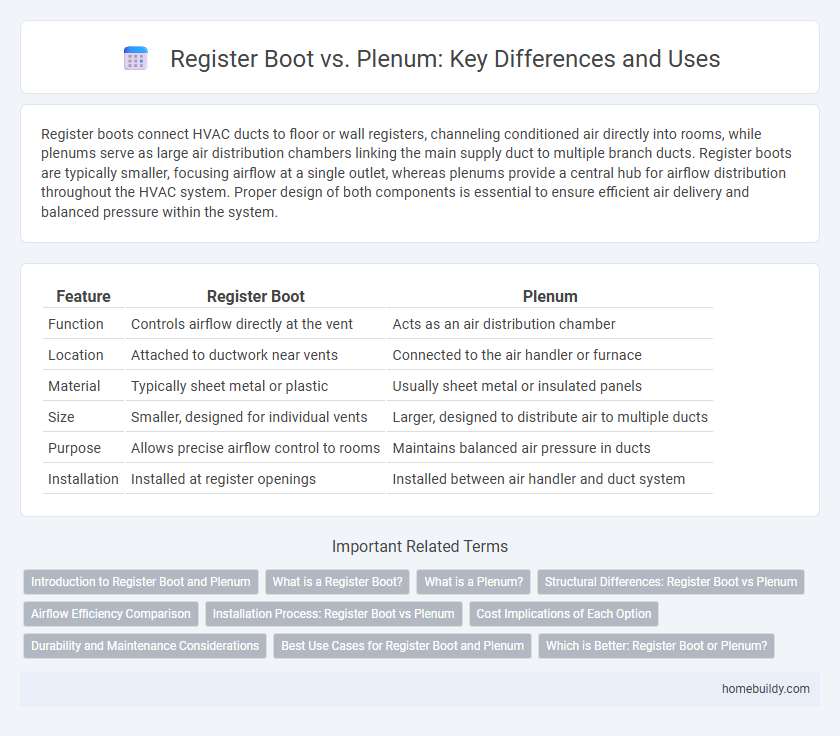
 Register boots connect HVAC ducts to floor or wall registers, channeling conditioned air directly into rooms, while plenums serve as large air distribution chambers linking the main supply duct to multiple branch ducts. Register boots are typically smaller, focusing airflow at a single outlet, whereas plenums provide a central hub for airflow distribution throughout the HVAC system. Proper design of both components is essential to ensure efficient air delivery and balanced pressure within the system.
Table of Comparison
| Feature | Register Boot | Plenum |
|---|---|---|
| Function | Controls airflow directly at the vent | Acts as an air distribution chamber |
| Location | Attached to ductwork near vents | Connected to the air handler or furnace |
| Material | Typically sheet metal or plastic | Usually sheet metal or insulated panels |
| Size | Smaller, designed for individual vents | Larger, designed to distribute air to multiple ducts |
| Purpose | Allows precise airflow control to rooms | Maintains balanced air pressure in ducts |
| Installation | Installed at register openings | Installed between air handler and duct system |
Introduction to Register Boot and Plenum
Register boots serve as a transitional component connecting ductwork to floor or wall vents, facilitating controlled airflow distribution in HVAC systems. Plenums function as central air chambers that collect and distribute conditioned air from the HVAC unit to various registers and ducts. Both components play crucial roles in maintaining efficient airflow and system pressure within heating and cooling installations.
What is a Register Boot?
A register boot is a duct transition component used in HVAC systems to connect the main supply air duct to a floor, wall, or ceiling register. It ensures efficient airflow distribution by adapting circular or rectangular ductwork to the register's opening size and shape. Unlike a plenum, which serves as an air distribution box within the HVAC system, a register boot specifically channels conditioned air from the duct to the indoor space through the register grill.
What is a Plenum?
A plenum is an air distribution space used in HVAC systems that allows air to flow evenly before entering the ductwork or registers. Unlike a register boot, which directly connects the duct to the register and serves as a transition piece, a plenum acts as a larger chamber or box that helps balance air pressure and airflow. Plenums are crucial for maintaining efficient air circulation and reducing noise within the ventilation system.
Structural Differences: Register Boot vs Plenum
Register boots feature a smaller, more controlled outlet area designed to connect directly to individual HVAC registers, optimizing airflow with a tapered shape. Plenums serve as larger air distribution chambers attached to the main HVAC system, facilitating even air pressure and volume distribution across multiple ducts. The structural differences center on size, shape, and function, with register boots providing targeted airflow control and plenums enabling broad air distribution.
Airflow Efficiency Comparison
Register boots provide more precise airflow control by connecting directly to duct openings with adjustable dampers, optimizing air distribution in HVAC systems. In contrast, plenums serve as large air distribution chambers, often causing pressure drops and less efficient airflow due to turbulence and volume changes. Comparing airflow efficiency, register boots minimize energy loss and improve system responsiveness, while plenums can lead to uneven pressure and reduced overall HVAC performance.
Installation Process: Register Boot vs Plenum
Register boot installation involves connecting a smaller, tapered duct directly to the supply opening, allowing for easier alignment and sealing with sheet metal screws and mastic. Plenum installation requires constructing a larger, box-like chamber that connects the main duct to multiple registers, which can be more complex and time-consuming due to its size and the need for precise sealing to prevent air leaks. The register boot offers a more straightforward, cost-effective installation process, while plenums provide better airflow distribution but demand meticulous assembly.
Cost Implications of Each Option
Register boots typically have lower upfront costs compared to plenums due to simpler design and materials, making them a budget-friendly choice for many HVAC systems. Plenums, although more expensive initially, provide enhanced airflow distribution and system efficiency, potentially reducing long-term energy expenses. Maintenance costs can also differ, with register boots generally requiring less frequent servicing than complex plenum setups.
Durability and Maintenance Considerations
Register boots typically offer enhanced durability compared to plenums due to their rigid construction, which resists wear and deformation over time. Maintenance is simplified with register boots as they provide easier access for inspection and cleaning, reducing the risk of debris buildup that can affect airflow quality. Plenums, while versatile, often require more frequent maintenance to address potential leaks and material degradation, impacting long-term performance.
Best Use Cases for Register Boot and Plenum
Register boot excels in residential HVAC systems where precise air flow control is needed for individual rooms, improving comfort and energy efficiency. Plenum is best suited for commercial or industrial settings with large-scale air distribution, providing even temperature and pressure throughout complex duct networks. Choosing register boot enhances targeted airflow management, while plenum optimizes overall system balance in extensive installations.
Which is Better: Register Boot or Plenum?
Register boots provide more efficient airflow control by directing conditioned air precisely through adjustable registers, optimizing comfort and energy use in HVAC systems. Plenums serve as larger air distribution chambers connecting HVAC components, but they lack the fine-tuning capability of register boots for individual room airflow. For targeted airflow management, register boots outperform plenums, enhancing system performance and occupant comfort.
Register boot vs plenum Infographic