 homebuildy.com
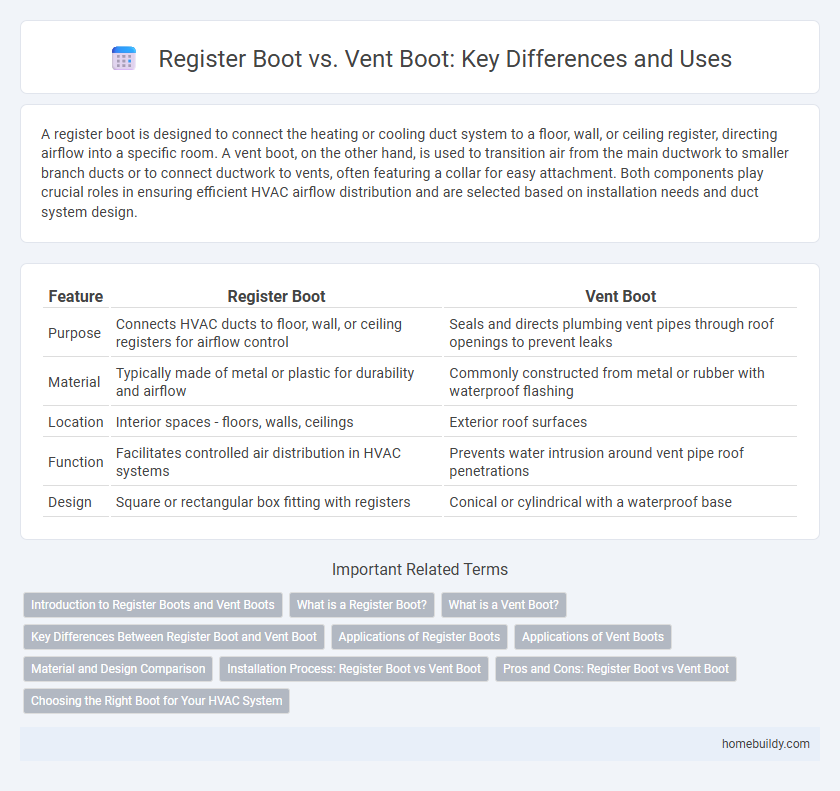
 A register boot is designed to connect the heating or cooling duct system to a floor, wall, or ceiling register, directing airflow into a specific room. A vent boot, on the other hand, is used to transition air from the main ductwork to smaller branch ducts or to connect ductwork to vents, often featuring a collar for easy attachment. Both components play crucial roles in ensuring efficient HVAC airflow distribution and are selected based on installation needs and duct system design.
Table of Comparison
| Feature | Register Boot | Vent Boot |
|---|---|---|
| Purpose | Connects HVAC ducts to floor, wall, or ceiling registers for airflow control | Seals and directs plumbing vent pipes through roof openings to prevent leaks |
| Material | Typically made of metal or plastic for durability and airflow | Commonly constructed from metal or rubber with waterproof flashing |
| Location | Interior spaces - floors, walls, ceilings | Exterior roof surfaces |
| Function | Facilitates controlled air distribution in HVAC systems | Prevents water intrusion around vent pipe roof penetrations |
| Design | Square or rectangular box fitting with registers | Conical or cylindrical with a waterproof base |
Introduction to Register Boots and Vent Boots
Register boots and vent boots serve distinct functions in HVAC systems, facilitating effective air distribution and ventilation. Register boots connect air ducts to registers, ensuring controlled airflow into rooms, while vent boots are designed to accommodate vent pipes, allowing safe expulsion of gases and air pressure regulation. Understanding the structural differences and installation purposes between register boots and vent boots is essential for optimizing HVAC performance.
What is a Register Boot?
A register boot is a metal or plastic component installed at the termination point of ductwork to connect air registers, enabling controlled airflow into a room. It features a rectangular or round shape that directly fits into wall, ceiling, or floor openings, ensuring an airtight seal and efficient air distribution. Unlike vent boots, register boots are specifically designed to accommodate adjustable registers for precise airflow control and comfort management.
What is a Vent Boot?
A vent boot is a specialized roofing component designed to seal around plumbing vents that penetrate the roof, preventing water leaks and ensuring proper ventilation. It typically consists of a rubber or silicone boot that fits snugly around the vent pipe, integrated with a metal or plastic flange that attaches securely to roofing materials. Vent boots differ from register boots by focusing on ventilation system penetrations rather than air registers, making them essential for maintaining roof integrity and indoor air quality.
Key Differences Between Register Boot and Vent Boot
Register boots are designed to fit over duct registers, providing a secure and adjustable connection for airflow control, while vent boots connect to vent terminals or exhaust outlets to facilitate air expulsion from HVAC systems. The key difference lies in their application: register boots manage conditioned air distribution within living spaces, whereas vent boots handle the release of air or gases outside the building structure. Material composition also varies, with register boots often featuring adjustable dampers and vent boots constructed to withstand external environmental conditions.
Applications of Register Boots
Register boots are primarily used for HVAC systems to connect ductwork to floor or wall registers, providing controlled airflow into rooms. They are ideal for residential and commercial applications where adjustable airflow and precise air distribution are needed to enhance comfort. Unlike vent boots that typically connect to ceiling or wall vents, register boots allow for efficient airflow control and are compatible with a variety of register sizes and styles.
Applications of Vent Boots
Vent boots are specifically designed for applications involving ventilation systems, such as exhaust vents, dryer vents, and bathroom fans, where waterproofing and preventing pest intrusion are critical. Unlike register boots, which connect rectangular ductwork to supply registers and are optimized for airflow distribution within HVAC systems, vent boots are tailored to exterior wall or roof penetrations to ensure proper sealing and weather resistance. Their robust design helps maintain system efficiency by protecting vent openings from moisture, debris, and air leaks in residential and commercial buildings.
Material and Design Comparison
Register boots are typically constructed from durable galvanized steel, featuring a rectangular design that fits snugly into ductwork for direct airflow distribution. Vent boots often use lightweight aluminum or galvanized steel with a round or oval shape optimized for exhaust or intake openings in roof or wall vents. The design difference impacts installation versatility, with register boots prioritizing secure duct connection while vent boots emphasize weather resistance and external venting efficiency.
Installation Process: Register Boot vs Vent Boot
Register boots are installed by securely attaching them to the ductwork and wall or floor surfaces, ensuring a tight seal for efficient air distribution. Vent boots require installation around vent pipes with a weatherproof flashing to prevent leaks and typically need roofing material integration for proper sealing. Both installations demand precise measurements and alignment to optimize HVAC performance and prevent air or moisture infiltration.
Pros and Cons: Register Boot vs Vent Boot
Register boots provide direct airflow control with adjustable vents, enhancing precision in distributing conditioned air, but they can become noisy and accumulate dust more easily. Vent boots offer broader airflow delivery and are typically quieter, reducing resistance in duct systems, yet they lack the fine-tuning capability of register boots. Choosing between register boot and vent boot depends on the need for airflow control versus noise level and ease of maintenance in HVAC systems.
Choosing the Right Boot for Your HVAC System
Register boots are designed to connect directly to the ductwork and support the airflow through vents, optimizing air distribution in HVAC systems, while vent boots primarily serve as mounting bases for air registers or grilles. Selecting the right boot requires considering factors like airflow volume, duct size, and installation location to ensure efficient heating or cooling performance. Properly matched register boots minimize air leakage and pressure loss, enhancing overall HVAC efficiency and comfort.
Register boot vs vent boot Infographic