 homebuildy.com
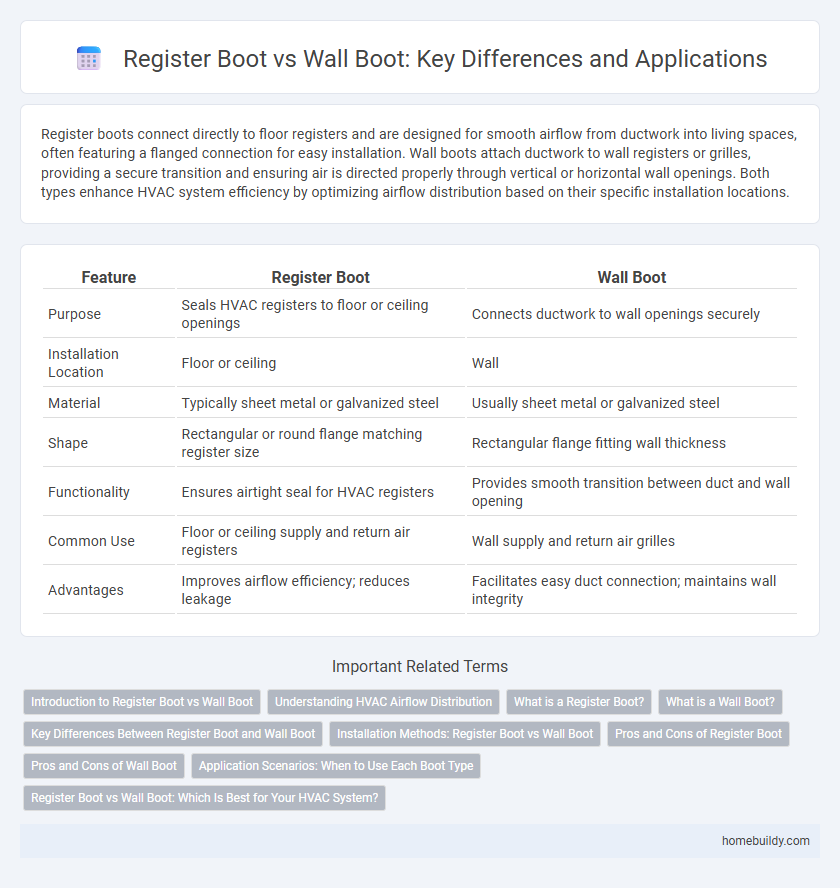
 Register boots connect directly to floor registers and are designed for smooth airflow from ductwork into living spaces, often featuring a flanged connection for easy installation. Wall boots attach ductwork to wall registers or grilles, providing a secure transition and ensuring air is directed properly through vertical or horizontal wall openings. Both types enhance HVAC system efficiency by optimizing airflow distribution based on their specific installation locations.
Table of Comparison
| Feature | Register Boot | Wall Boot |
|---|---|---|
| Purpose | Seals HVAC registers to floor or ceiling openings | Connects ductwork to wall openings securely |
| Installation Location | Floor or ceiling | Wall |
| Material | Typically sheet metal or galvanized steel | Usually sheet metal or galvanized steel |
| Shape | Rectangular or round flange matching register size | Rectangular flange fitting wall thickness |
| Functionality | Ensures airtight seal for HVAC registers | Provides smooth transition between duct and wall opening |
| Common Use | Floor or ceiling supply and return air registers | Wall supply and return air grilles |
| Advantages | Improves airflow efficiency; reduces leakage | Facilitates easy duct connection; maintains wall integrity |
Introduction to Register Boot vs Wall Boot
Register boot and wall boot are essential components in HVAC systems that direct airflow from ducts to the living space. A register boot typically connects the ductwork to a floor or ceiling register, managing airflow with adjustable dampers, while a wall boot serves as the transition piece between ductwork and wall-mounted registers. Understanding the distinctions between these boots aids in optimizing airflow efficiency and installation compatibility within heating and cooling systems.
Understanding HVAC Airflow Distribution
Register boots and wall boots are essential HVAC components that influence airflow distribution by directing conditioned air from ductwork into living spaces. Register boots typically connect to floor registers, optimizing airflow direction and velocity for efficient room air circulation. Wall boots, attached to wall vents, facilitate lateral airflow and can impact temperature regulation by affecting how air disperses horizontally within a room.
What is a Register Boot?
A register boot is a metal or plastic enclosure designed to connect HVAC ductwork to floor, ceiling, or wall registers, facilitating efficient airflow distribution. It differs from a wall boot in that register boots typically attach to floor or ceiling registers and are more compact, while wall boots are specifically designed for wall-mounted air vents with larger dimensions to accommodate vertical airflow. Register boots help ensure airtight connections and proper air diffusion in heating and cooling systems.
What is a Wall Boot?
A wall boot is a duct component designed to connect rectangular or round ductwork to a wall, providing a secure and sealed transition for HVAC airflows. Unlike a register boot, which is typically floor-mounted and connects to floor registers, a wall boot is installed within wall cavities and supports the attachment of wall registers or grilles. Its construction often includes flanges for fastening to wall studs and insulation to prevent air leakage and improve energy efficiency.
Key Differences Between Register Boot and Wall Boot
Register boots are designed to connect supply or return ducts directly to registers, providing a smooth transition and efficient airflow, while wall boots attach to wall openings for air distribution. Register boots typically feature rectangular or round collars for easy attachment to ductwork, whereas wall boots are specially shaped to fit wall openings with flange edges for secure mounting. The main difference lies in their installation location and intended function: register boots focus on interfacing with ductwork and registers, whereas wall boots serve as the interface between the wall surface and the HVAC system.
Installation Methods: Register Boot vs Wall Boot
Register boots install directly onto the HVAC ductwork, creating a seamless transition between the duct and the vent register for straightforward attachment and alignment. Wall boots require integration into a wall or floor surface, typically needing a cutout and additional framing or sealing to ensure structural support and airtightness. Installation efficiency often favors register boots due to their plug-and-play design, while wall boots demand more labor and precision for proper mounting and insulation.
Pros and Cons of Register Boot
Register boots offer a sleek, integrated look by seamlessly connecting duct registers to boot fittings, improving airflow efficiency and reducing leakage compared to wall boots. They simplify installation in tight spaces and provide better support for adjustable grilles but may require precise measurements to avoid fit issues and can be less accessible for maintenance. Unlike wall boots, register boots limit placement flexibility, potentially restricting vent location options in complex architectural layouts.
Pros and Cons of Wall Boot
Wall boots offer enhanced stability and support for register installations by securely anchoring the duct to the wall, reducing vibrations and noise transmission. However, they require precise wall cutting and may complicate maintenance access compared to register boots, which are easier to install and replace. Wall boots provide a cleaner aesthetic by being recessed into the wall, but this can increase installation time and cost.
Application Scenarios: When to Use Each Boot Type
Register boots are ideal for HVAC systems that require easy access for cleaning and maintenance, typically found in ceiling or wall registers within residential and commercial buildings. Wall boots are better suited for penetrating walls or floors to connect ductwork, providing a secure and airtight transition in both new construction and retrofit projects. Choose register boots for accessibility and aesthetic integration, while wall boots excel in structural support and sealed duct connections.
Register Boot vs Wall Boot: Which Is Best for Your HVAC System?
Register boots and wall boots serve as essential HVAC components, directing airflow from ductwork into living spaces. Register boots generally feature a flange for easy installation within finished walls or floors, providing a neat, flush fit with adjustable dampers for precise airflow control. Wall boots attach directly to exterior walls, facilitating secure venting for exhaust or intake purposes, often preferred for systems requiring direct outdoor air exchange or venting.
Register boot vs wall boot Infographic