 homebuildy.com
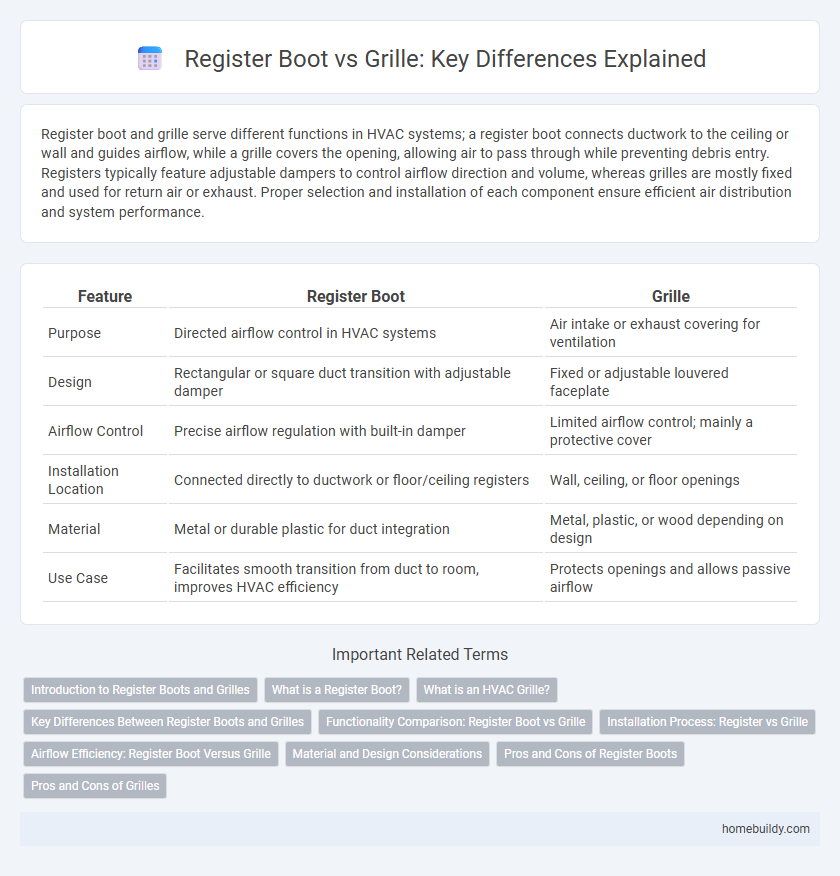
 Register boot and grille serve different functions in HVAC systems; a register boot connects ductwork to the ceiling or wall and guides airflow, while a grille covers the opening, allowing air to pass through while preventing debris entry. Registers typically feature adjustable dampers to control airflow direction and volume, whereas grilles are mostly fixed and used for return air or exhaust. Proper selection and installation of each component ensure efficient air distribution and system performance.
Table of Comparison
| Feature | Register Boot | Grille |
|---|---|---|
| Purpose | Directed airflow control in HVAC systems | Air intake or exhaust covering for ventilation |
| Design | Rectangular or square duct transition with adjustable damper | Fixed or adjustable louvered faceplate |
| Airflow Control | Precise airflow regulation with built-in damper | Limited airflow control; mainly a protective cover |
| Installation Location | Connected directly to ductwork or floor/ceiling registers | Wall, ceiling, or floor openings |
| Material | Metal or durable plastic for duct integration | Metal, plastic, or wood depending on design |
| Use Case | Facilitates smooth transition from duct to room, improves HVAC efficiency | Protects openings and allows passive airflow |
Introduction to Register Boots and Grilles
Register boots and grilles are essential components in HVAC systems designed to facilitate efficient air distribution. Register boots serve as the connecting ducts between the main air supply and wall or floor grilles, directing airflow smoothly from the ductwork to the vent openings. Grilles act as the visible cover, protecting the duct openings while allowing air to flow into or out of a room, often equipped with adjustable louvers to control airflow direction and volume.
What is a Register Boot?
A register boot is a duct transition fitting that connects the ductwork to an air register or grille, ensuring efficient airflow distribution in HVAC systems. Unlike a grille, which is primarily a decorative cover with slots for air passage, a register boot includes the plenum and collar to secure the duct connection and support directional airflow control. Register boots are essential for maintaining air pressure and flow within heating and cooling systems, optimizing comfort and energy efficiency.
What is an HVAC Grille?
An HVAC grille is a decorative and functional cover installed over an air duct opening, designed to direct the airflow within a space while preventing debris from entering the duct system. Unlike registers that contain adjustable dampers for controlling airflow, grilles typically have fixed slats or louvers and do not regulate air volume. HVAC grilles come in various sizes and styles, often matching interior aesthetics while ensuring efficient air distribution and return ventilation.
Key Differences Between Register Boots and Grilles
Register boots control and direct airflow from HVAC ductwork into rooms by attaching directly to the duct opening, featuring adjustable dampers for precise airflow regulation. Grilles primarily cover duct openings or air returns, allowing air to pass freely without controlling flow, and generally lack dampers or directional control features. Registers are essential for optimizing airflow efficiency and comfort, while grilles serve a protective and aesthetic function in HVAC systems.
Functionality Comparison: Register Boot vs Grille
Register boots and grilles serve distinct HVAC functions, with register boots acting as intermediate ducts that connect ductwork to registers or grilles, ensuring controlled airflow distribution. Registers feature adjustable dampers for regulating air volume and direction, while grilles typically function as fixed covers without airflow control capabilities. Understanding the difference in airflow management and installation roles is essential for optimizing HVAC system performance and indoor comfort.
Installation Process: Register vs Grille
The installation process for registers involves securing the frame flush with the wall or floor surface, typically using screws through pre-drilled holes for a stable, seamless fit. In contrast, grille installation often requires mounting brackets or clips to hold the lightweight frame slightly recessed or flush, allowing for easier removal and cleaning. Registers often include built-in dampers that must be adjusted during installation to control airflow, a feature not commonly found in simple grilles.
Airflow Efficiency: Register Boot Versus Grille
Register boots enhance airflow efficiency by providing a sealed connection between ductwork and grille, minimizing air leaks and maintaining consistent pressure. Grilles typically allow more air leakage due to their open design and lack of a sealed connection, reducing overall HVAC system performance. Efficient airflow through register boots reduces energy consumption and improves indoor air distribution compared to using grilles alone.
Material and Design Considerations
Register boots are typically constructed from durable galvanized steel or aluminum to withstand high airflow and temperature variations, ensuring long-term performance in HVAC systems. Grilles are often made from lighter materials such as plastic or painted steel, designed primarily for aesthetics and airflow regulation rather than structural strength. The design of register boots emphasizes airtight connections with ductwork to minimize leakage, while grilles focus on decorative patterns and adjustable louvers for directional airflow control.
Pros and Cons of Register Boots
Register boots offer enhanced airflow control and easier maintenance compared to grilles, allowing precise directional adjustment of air vents. They typically provide a tighter seal, reducing air leakage and improving HVAC system efficiency, but installation can be more complex and costly. Conversely, grilles are simpler and cheaper to install but lack the fine-tuned airflow control and sealing benefits of register boots.
Pros and Cons of Grilles
Grilles offer greater airflow control and enhanced aesthetic options compared to register boots, allowing for customizable ventilation patterns in HVAC systems. However, grilles may be less effective at directing airflow precisely, which can result in uneven room temperature distribution. Maintenance can also be more challenging, as grilles tend to accumulate dust and debris faster than register boots, impacting air quality over time.
Register boot vs Grille Infographic