 homebuildy.com
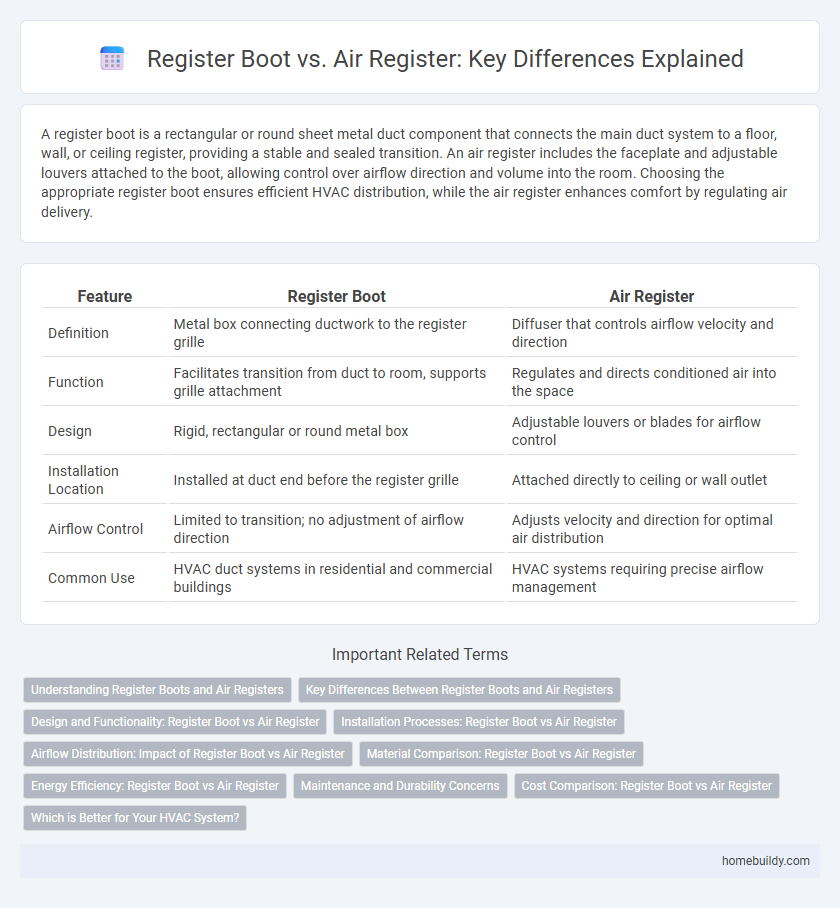
 A register boot is a rectangular or round sheet metal duct component that connects the main duct system to a floor, wall, or ceiling register, providing a stable and sealed transition. An air register includes the faceplate and adjustable louvers attached to the boot, allowing control over airflow direction and volume into the room. Choosing the appropriate register boot ensures efficient HVAC distribution, while the air register enhances comfort by regulating air delivery.
Table of Comparison
| Feature | Register Boot | Air Register |
|---|---|---|
| Definition | Metal box connecting ductwork to the register grille | Diffuser that controls airflow velocity and direction |
| Function | Facilitates transition from duct to room, supports grille attachment | Regulates and directs conditioned air into the space |
| Design | Rigid, rectangular or round metal box | Adjustable louvers or blades for airflow control |
| Installation Location | Installed at duct end before the register grille | Attached directly to ceiling or wall outlet |
| Airflow Control | Limited to transition; no adjustment of airflow direction | Adjusts velocity and direction for optimal air distribution |
| Common Use | HVAC duct systems in residential and commercial buildings | HVAC systems requiring precise airflow management |
Understanding Register Boots and Air Registers
Register boots are essential components in HVAC systems, designed to channel air from the ductwork into the living space efficiently, while air registers serve as the grilles or vents that cover these boots and allow adjustable airflow control. The primary distinction lies in their functions: register boots act as conduits connecting ducts to rooms, whereas air registers regulate and direct the airflow entering the room. Understanding the complementary roles of register boots and air registers ensures optimal air distribution and improved indoor comfort.
Key Differences Between Register Boots and Air Registers
Register boots provide a secure connection between HVAC ductwork and floor, wall, or ceiling registers, ensuring controlled airflow direction and distribution. Air registers combine a grille and adjustable damper, allowing users to regulate airflow volume and direction at the point of delivery. The key differences lie in their function and installation, with register boots serving as a duct transition piece and air registers offering user-adjustable airflow control.
Design and Functionality: Register Boot vs Air Register
Register boots feature a tapered design that directs airflow efficiently from the duct to the register, optimizing air distribution and minimizing noise. In contrast, air registers incorporate adjustable dampers allowing precise control of airflow volume and direction directly at the outlet. The functionality of register boots centers on connecting ductwork to registers, while air registers enhance user comfort through customizable ventilation settings.
Installation Processes: Register Boot vs Air Register
Register boot installation requires securely connecting the boot to the ductwork and attaching the register face, ensuring a tight seal to prevent air leaks. Air register installation involves mounting the register directly onto the wall or ceiling opening without the need for a duct boot, simplifying the process but potentially reducing airflow control. Proper sealing and alignment are critical in both methods to optimize HVAC system efficiency and indoor air distribution.
Airflow Distribution: Impact of Register Boot vs Air Register
Register boots provide more controlled and directed airflow distribution by connecting ductwork directly to the register, minimizing air leakage and enhancing efficiency. Air registers, equipped with adjustable louvers, offer flexible airflow direction within the room but may cause uneven air distribution if not properly aligned. Optimizing the balance between register boot precision and air register adjustability improves overall HVAC system performance and occupant comfort.
Material Comparison: Register Boot vs Air Register
Register boots are typically constructed from galvanized steel or aluminum, offering superior durability and resistance to corrosion compared to air registers, which are often made from lightweight plastic or thin metal. The thicker gauge metal used in register boots improves airflow efficiency and reduces noise, while air registers prioritize aesthetic design with adjustable louvers for airflow control. Material choice directly impacts longevity, performance, and maintenance requirements between register boots and air registers in HVAC systems.
Energy Efficiency: Register Boot vs Air Register
Register boots are more energy efficient than air registers due to their ability to create an airtight seal, minimizing air leakage and heat loss in HVAC systems. The sealed connection between the duct and the boot reduces energy waste and improves airflow control, leading to lower utility costs. In contrast, air registers often allow for stray air leakage, decreasing overall system efficiency and increasing energy consumption.
Maintenance and Durability Concerns
Register boots typically require less frequent maintenance compared to air registers due to their simpler design and fewer moving parts. The robust construction of register boots enhances durability, reducing wear and tear over time in HVAC systems. Air registers, with adjustable dampers, may demand more regular inspections and cleaning to maintain optimal airflow and prevent mechanical failures.
Cost Comparison: Register Boot vs Air Register
Register boots generally offer a more cost-effective solution compared to air registers, primarily due to their simpler design and easier installation process. The material expenses for register boots are typically lower, with fewer components needed, which reduces both initial outlay and maintenance costs. In contrast, air registers tend to involve higher manufacturing and labor costs, making them a pricier option for HVAC ductwork systems.
Which is Better for Your HVAC System?
Register boots provide a secure connection between ductwork and supply registers, ensuring efficient airflow in residential HVAC systems. Air registers integrate adjustable dampers that allow precise control over air distribution and room temperature, enhancing comfort and energy efficiency. Choosing between a register boot and an air register depends on factors like duct sizing, airflow requirements, and desired control, with air registers often preferred for their flexibility in balancing HVAC performance.
Register boot vs air register Infographic