 homebuildy.com
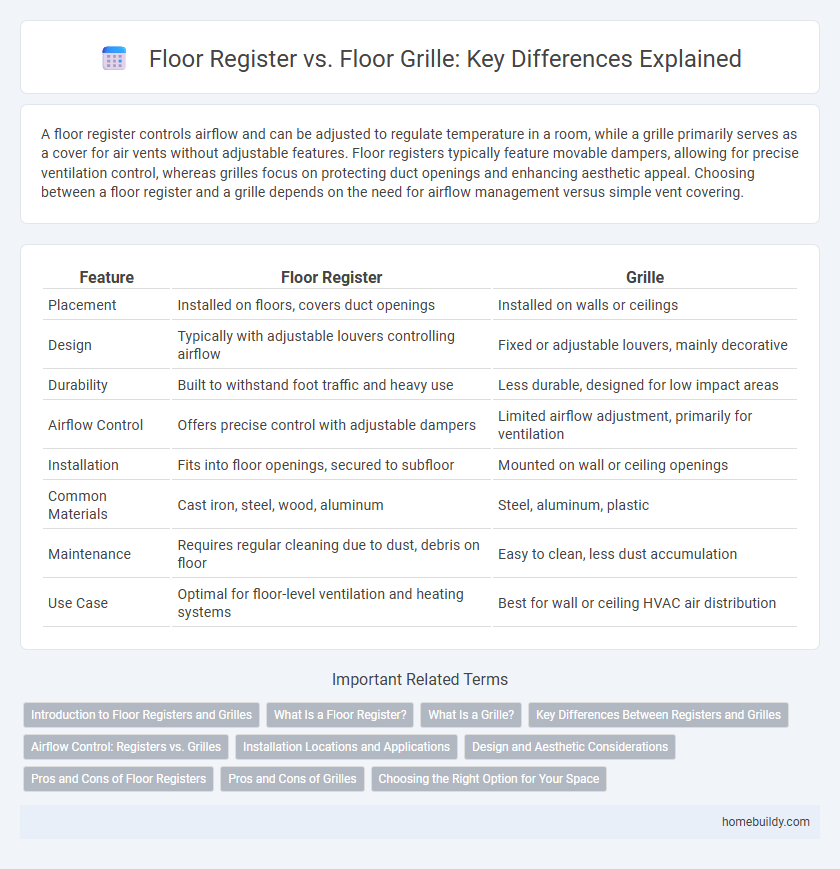
 A floor register controls airflow and can be adjusted to regulate temperature in a room, while a grille primarily serves as a cover for air vents without adjustable features. Floor registers typically feature movable dampers, allowing for precise ventilation control, whereas grilles focus on protecting duct openings and enhancing aesthetic appeal. Choosing between a floor register and a grille depends on the need for airflow management versus simple vent covering.
Table of Comparison
| Feature | Floor Register | Grille |
|---|---|---|
| Placement | Installed on floors, covers duct openings | Installed on walls or ceilings |
| Design | Typically with adjustable louvers controlling airflow | Fixed or adjustable louvers, mainly decorative |
| Durability | Built to withstand foot traffic and heavy use | Less durable, designed for low impact areas |
| Airflow Control | Offers precise control with adjustable dampers | Limited airflow adjustment, primarily for ventilation |
| Installation | Fits into floor openings, secured to subfloor | Mounted on wall or ceiling openings |
| Common Materials | Cast iron, steel, wood, aluminum | Steel, aluminum, plastic |
| Maintenance | Requires regular cleaning due to dust, debris on floor | Easy to clean, less dust accumulation |
| Use Case | Optimal for floor-level ventilation and heating systems | Best for wall or ceiling HVAC air distribution |
Introduction to Floor Registers and Grilles
Floor registers and grilles serve as essential components in HVAC systems, facilitating airflow regulation within indoor environments. Floor registers typically feature adjustable louvers that allow homeowners to control the direction and volume of air, optimizing comfort and energy efficiency. Unlike grilles, which often provide passive airflow cover without adjustment capabilities, floor registers are designed for both airflow control and aesthetic integration into flooring surfaces.
What Is a Floor Register?
A floor register is a vent cover installed over floor duct openings, designed to control airflow from HVAC systems into a room. Unlike a grille, which primarily allows air passage and often has fixed openings, a floor register features adjustable louvers to regulate air volume and direction. Made typically from metal or wood, floor registers are essential for efficient heating and cooling, balancing indoor air distribution.
What Is a Grille?
A grille is an architectural component designed to cover air vents while allowing airflow between spaces, typically composed of metal or plastic with adjustable or fixed slats. Unlike floor registers, grilles are often installed on walls or ceilings and do not include a damper to control airflow. Grilles serve both functional and decorative purposes, providing ventilation without obstructing aesthetic design elements.
Key Differences Between Registers and Grilles
Floor registers differ from grilles primarily in their functionality and design; registers contain adjustable dampers that control airflow, while grilles serve solely as protective covers without airflow modulation. Registers are typically installed in floors to distribute heated or cooled air efficiently, whereas grilles are often used on walls or ceilings for return air or exhaust purposes. The material and size of registers are chosen to withstand foot traffic, making them more durable compared to the usually lighter and purely decorative grilles.
Airflow Control: Registers vs. Grilles
Floor registers feature adjustable dampers that enable precise airflow control, allowing users to regulate the volume and direction of air entering a room. In contrast, grilles lack movable components and primarily serve as static covers, providing minimal influence over airflow distribution. This difference makes floor registers essential for optimizing heating and cooling efficiency in HVAC systems.
Installation Locations and Applications
Floor registers are typically installed in flooring to cover heating and cooling duct openings, allowing air to flow upward into living spaces, while grilles are often mounted on walls or ceilings to facilitate air intake or return ventilation. Floor registers are designed for high foot traffic areas due to their sturdy construction and low profile, making them ideal for residential rooms and office floors. Grilles, on the other hand, serve diverse applications including return air pathways and exhaust vents in HVAC systems, offering broader placement flexibility beyond just the floor.
Design and Aesthetic Considerations
Floor registers offer a sleek, low-profile design that seamlessly integrates with hardwood or tile flooring, enhancing room aesthetics without disrupting the surface continuity. Grilles, typically installed on walls or ceilings, come in a variety of styles and materials, allowing for decorative customization but often protruding slightly from the surface. Choosing between a floor register and grille depends on the desired visual impact and interior design preferences, with floor registers emphasizing subtlety and grilles offering more prominent stylistic statements.
Pros and Cons of Floor Registers
Floor registers provide efficient airflow control with adjustable dampers, enhancing room temperature regulation and energy savings. They are durable and suitable for high-traffic areas but may accumulate dust and debris more easily than grilles, requiring regular cleaning. Unlike grilles, floor registers can create noise when opening or closing, potentially affecting indoor comfort.
Pros and Cons of Grilles
Grilles offer a sleek design that blends seamlessly with flooring, enhancing aesthetic appeal while providing effective airflow regulation in HVAC systems. They can be easier to clean and maintain compared to floor registers but may allow more debris to enter ducts due to less robust covering. However, grilles sometimes produce more noise and may not seal as tightly as registers, potentially impacting energy efficiency.
Choosing the Right Option for Your Space
Floor registers and grilles serve different airflow and aesthetic needs in HVAC systems, with floor registers offering adjustable dampers for precise airflow control, while grilles provide fixed ventilation openings. Selecting the right option depends on factors such as room layout, airflow requirements, and design preferences, with floor registers suited for direct floor-based air distribution and grilles ideal for wall or ceiling installations. Proper evaluation of ventilation efficiency, maintenance ease, and material durability ensures the chosen ventilation component optimizes indoor air quality and complements the space's functionality.
Floor register vs grille Infographic