 homebuildy.com
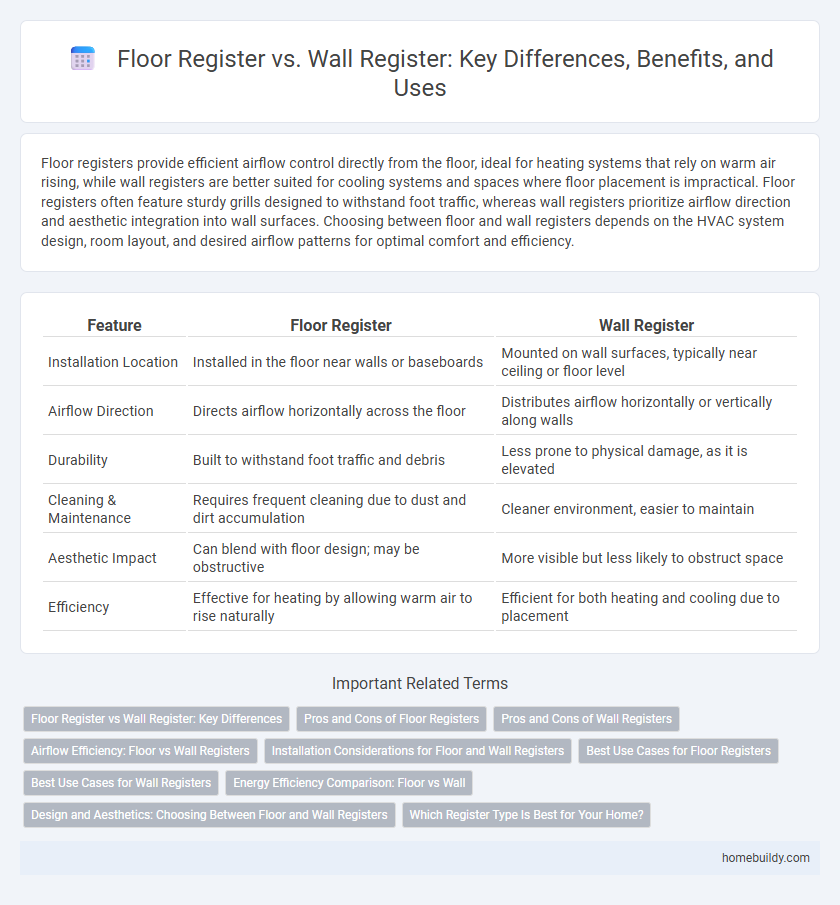
 Floor registers provide efficient airflow control directly from the floor, ideal for heating systems that rely on warm air rising, while wall registers are better suited for cooling systems and spaces where floor placement is impractical. Floor registers often feature sturdy grills designed to withstand foot traffic, whereas wall registers prioritize airflow direction and aesthetic integration into wall surfaces. Choosing between floor and wall registers depends on the HVAC system design, room layout, and desired airflow patterns for optimal comfort and efficiency.
Table of Comparison
| Feature | Floor Register | Wall Register |
|---|---|---|
| Installation Location | Installed in the floor near walls or baseboards | Mounted on wall surfaces, typically near ceiling or floor level |
| Airflow Direction | Directs airflow horizontally across the floor | Distributes airflow horizontally or vertically along walls |
| Durability | Built to withstand foot traffic and debris | Less prone to physical damage, as it is elevated |
| Cleaning & Maintenance | Requires frequent cleaning due to dust and dirt accumulation | Cleaner environment, easier to maintain |
| Aesthetic Impact | Can blend with floor design; may be obstructive | More visible but less likely to obstruct space |
| Efficiency | Effective for heating by allowing warm air to rise naturally | Efficient for both heating and cooling due to placement |
Floor Register vs Wall Register: Key Differences
Floor registers are installed directly in the floor, allowing warm or cool air to flow upward, enhancing HVAC efficiency in rooms with lower heating or cooling requirements. Wall registers are mounted on walls, typically near ceilings, providing better air circulation for rooms with higher or more uniform temperature control needs. Differences in airflow direction, installation location, and aesthetic impact are key factors when choosing between floor registers and wall registers for HVAC systems.
Pros and Cons of Floor Registers
Floor registers provide efficient airflow distribution and are ideal for heating systems that rely on warm air rising from the floor, enhancing room comfort. However, they can collect dust and debris more easily and may pose tripping hazards, requiring regular cleaning and strategic placement. Compared to wall registers, floor registers are less prone to obstruction from furniture but may suffer from damage due to foot traffic.
Pros and Cons of Wall Registers
Wall registers offer easier access for cleaning and adjusting airflow compared to floor registers, reducing the risk of blockage by furniture or debris. They are less prone to damage from foot traffic and are ideal for rooms with carpeting or hardwood floors where floor registers might be impractical. However, wall registers may limit airflow distribution in certain layouts and can be less effective in heating or cooling rooms evenly if improperly positioned.
Airflow Efficiency: Floor vs Wall Registers
Floor registers typically offer superior airflow efficiency compared to wall registers by allowing warm air to rise naturally, enhancing room circulation and reducing energy consumption. Wall registers can sometimes restrict airflow due to their placement, leading to uneven temperature distribution and increased HVAC system workload. Optimal airflow efficiency depends on strategic placement corresponding to room layout and HVAC system design, with floor registers generally favored for maximizing airflow performance.
Installation Considerations for Floor and Wall Registers
Floor registers require installation within the flooring surface, necessitating precise measurements and cutting of floorboards or subfloor materials to ensure a secure fit and prevent air leakage. Wall registers must be mounted onto or recessed into the wall framing, often requiring access to wall cavities and consideration of stud spacing to maintain structural integrity and proper airflow. Both installations demand attention to duct alignment, sealing with appropriate materials, and compatibility with HVAC system dimensions to optimize air distribution efficiency.
Best Use Cases for Floor Registers
Floor registers are ideal for rooms with hardwood or tile flooring where air circulation from the floor enhances heating efficiency, especially in living rooms and hallways. They work best in spaces that require unobstructed airflow without wall or window interference, supporting even temperature distribution. Floor registers also complement radiant heating systems by allowing warm air to rise naturally and improve overall comfort.
Best Use Cases for Wall Registers
Wall registers are ideal for rooms with limited floor space or heavy foot traffic, as they prevent obstruction and reduce wear. They work best in areas where air distribution needs to avoid furniture placement, such as living rooms or offices with wall-mounted cabinetry. Wall registers also improve airflow control in multi-room HVAC systems by directing air at a higher level.
Energy Efficiency Comparison: Floor vs Wall
Floor registers generally offer superior energy efficiency compared to wall registers by promoting better heat distribution through natural convection, as warm air rises evenly across the room. Their placement on the floor minimizes thermal bridging and reduces air leakage, ensuring consistent temperature regulation and lowering HVAC energy consumption. Wall registers often face challenges with airflow obstructions and uneven heat dispersion, which can decrease overall system efficiency and increase operating costs.
Design and Aesthetics: Choosing Between Floor and Wall Registers
Floor registers offer a low-profile design that blends seamlessly with hardwood, tile, or carpeted floors, enhancing room aesthetics with subtlety and minimal visual interruption. Wall registers provide more design flexibility regarding placement height and style, allowing them to become a prominent architectural feature that can complement moldings and wall finishes. Selecting between floor and wall registers depends on desired airflow direction, room layout, and the preferred balance between functional airflow and interior decor integration.
Which Register Type Is Best for Your Home?
Floor registers offer superior airflow control and heat distribution, making them ideal for rooms with limited wall space or larger heating systems. Wall registers provide a sleek, space-saving solution, fitting well in tighter spaces and often easier to access for cleaning and adjustments. Choosing the best register type depends on your home's layout, heating system efficiency, and personal preference for airflow and aesthetic integration.
Floor register vs wall register Infographic