 homebuildy.com
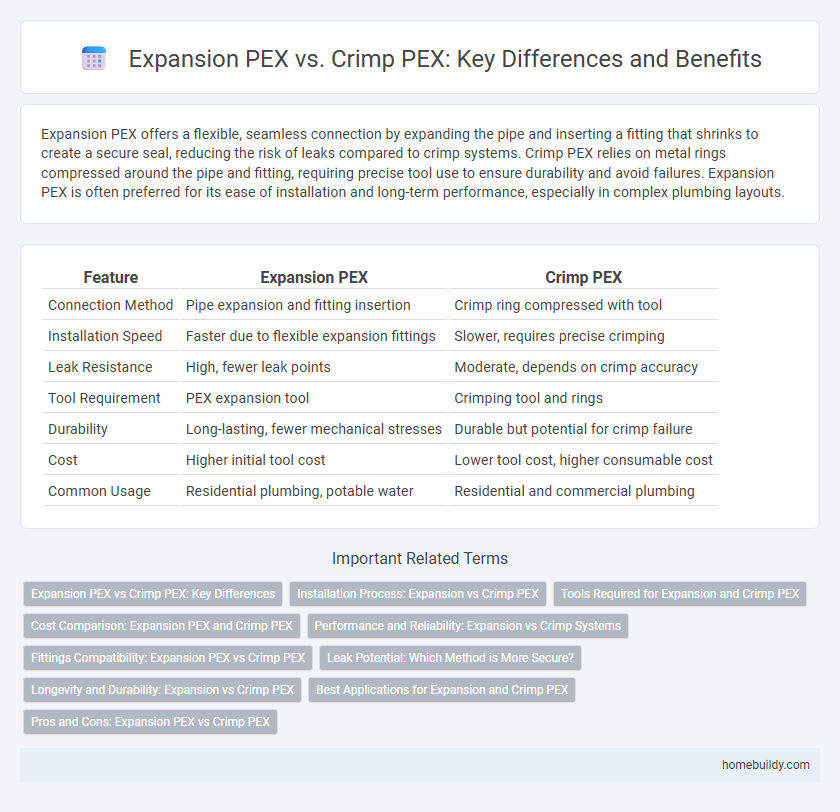
 Expansion PEX offers a flexible, seamless connection by expanding the pipe and inserting a fitting that shrinks to create a secure seal, reducing the risk of leaks compared to crimp systems. Crimp PEX relies on metal rings compressed around the pipe and fitting, requiring precise tool use to ensure durability and avoid failures. Expansion PEX is often preferred for its ease of installation and long-term performance, especially in complex plumbing layouts.
Table of Comparison
| Feature | Expansion PEX | Crimp PEX |
|---|---|---|
| Connection Method | Pipe expansion and fitting insertion | Crimp ring compressed with tool |
| Installation Speed | Faster due to flexible expansion fittings | Slower, requires precise crimping |
| Leak Resistance | High, fewer leak points | Moderate, depends on crimp accuracy |
| Tool Requirement | PEX expansion tool | Crimping tool and rings |
| Durability | Long-lasting, fewer mechanical stresses | Durable but potential for crimp failure |
| Cost | Higher initial tool cost | Lower tool cost, higher consumable cost |
| Common Usage | Residential plumbing, potable water | Residential and commercial plumbing |
Expansion PEX vs Crimp PEX: Key Differences
Expansion PEX uses a unique expansion tool to enlarge the pipe end, allowing it to fit over a fitting before contracting to form a secure, leak-proof seal, whereas Crimp PEX involves compressing a metal ring around the pipe and fitting with a crimping tool. Expansion PEX connections eliminate the need for metal rings and provide greater flexibility and durability, making them ideal for applications requiring thermal expansion. Crimp PEX is typically faster to install and more widely compatible with standard fittings but can be prone to leaks if crimps are not properly executed.
Installation Process: Expansion vs Crimp PEX
Expansion PEX installation involves using a specialized expansion tool to widen the pipe end before fitting it over the connection, allowing it to contract and form a secure seal as it returns to its original size. Crimp PEX requires placing a metal ring over the pipe and fitting, then compressing the ring with a crimping tool to create a watertight connection instantly. Expansion PEX often demands precise timing and skill for proper sealing, while Crimp PEX offers a quicker, more straightforward installation process suited for various plumbing applications.
Tools Required for Expansion and Crimp PEX
Expansion PEX requires specialized expansion tools that stretch the pipe before fitting insertion, ensuring a secure, seamless joint without the need for metal rings. Crimp PEX utilizes crimping tools and copper or stainless steel rings to compress the pipe around the fitting, creating a strong mechanical seal. While expansion tools offer a contamination-free connection ideal for potable water, crimp tools are generally more affordable and widely available for various plumbing applications.
Cost Comparison: Expansion PEX and Crimp PEX
Expansion PEX systems generally have higher upfront costs due to specialized tools and fittings, while Crimp PEX offers a more affordable initial investment with widely available equipment. Over time, Expansion PEX may reduce labor expenses because of faster installation speeds and fewer leak risks, potentially balancing the initial expense gap. The overall cost-effectiveness depends on project scale, labor rates, and material availability in the plumbing market.
Performance and Reliability: Expansion vs Crimp Systems
Expansion PEX systems offer superior joints that are less prone to leaks due to the absence of metal rings, enhancing long-term reliability in plumbing installations. Crimp PEX relies on metal rings compressed onto fittings, which may be susceptible to corrosion and mechanical failure over time, potentially reducing overall performance. The flexibility and uniform expansion of Expansion PEX contribute to better pressure resistance and durability compared to the mechanical crimp connections, making it a preferred choice for high-demand plumbing environments.
Fittings Compatibility: Expansion PEX vs Crimp PEX
Expansion PEX uses special fittings designed to fit expanded pipe walls, requiring expansion tools for installation and providing a seamless connection that reduces leak risks. Crimp PEX relies on metal rings that compress the pipe onto standard fittings using a crimping tool, ensuring compatibility with a wide range of metal and plastic fittings. Both systems demand specific fittings and tools, but Expansion PEX fittings generally offer greater flexibility in joint movement compared to the rigid connections of Crimp PEX.
Leak Potential: Which Method is More Secure?
Expansion PEX employs seamless fittings that expand the pipe and then contract to form a tight seal, significantly reducing leak potential by eliminating compression marks and weak points. Crimp PEX uses metal rings compressed around the pipe and fitting, which can sometimes lead to inconsistencies and increased risk of leaks if not installed perfectly. Studies show that properly installed Expansion PEX systems generally demonstrate higher resistance to leaks over time compared to crimping methods.
Longevity and Durability: Expansion vs Crimp PEX
Expansion PEX offers superior longevity due to its ability to maintain a secure, flexible connection that withstands temperature fluctuations and pressure changes without corroding or cracking. Crimp PEX relies on metal rings that can degrade over time, potentially leading to leaks and reduced durability. For long-term reliability, Expansion PEX systems provide enhanced resistance to wear and environmental stress factors compared to Crimp PEX.
Best Applications for Expansion and Crimp PEX
Expansion PEX tubing is best suited for applications requiring flexible, joint-free connections such as radiant heating systems and retrofit plumbing where frequent bends are necessary. Crimp PEX fittings are ideal for high-pressure water supply lines and new construction projects, offering quick, leak-proof connections with durable metal clamps. Choose Expansion PEX for ease of installation in tight spaces, while Crimp PEX provides strong mechanical joints suitable for long-term durability and inspection.
Pros and Cons: Expansion PEX vs Crimp PEX
Expansion PEX offers a secure, chemical-free joint by expanding the pipe before inserting a fitting, reducing the risk of leaks and allowing for greater flexibility in tight spaces, though it requires specialized expansion tools and precise technique. Crimp PEX utilizes metal rings compressed with a crimping tool around the pipe and fitting, making installation straightforward and cost-effective, but it carries a higher risk of leaks due to potential over or under-crimping and metal ring corrosion over time. Choosing between Expansion and Crimp PEX depends on factors such as budget, ease of installation, and long-term reliability in plumbing systems.
Expansion PEX vs Crimp PEX Infographic