 homebuildy.com
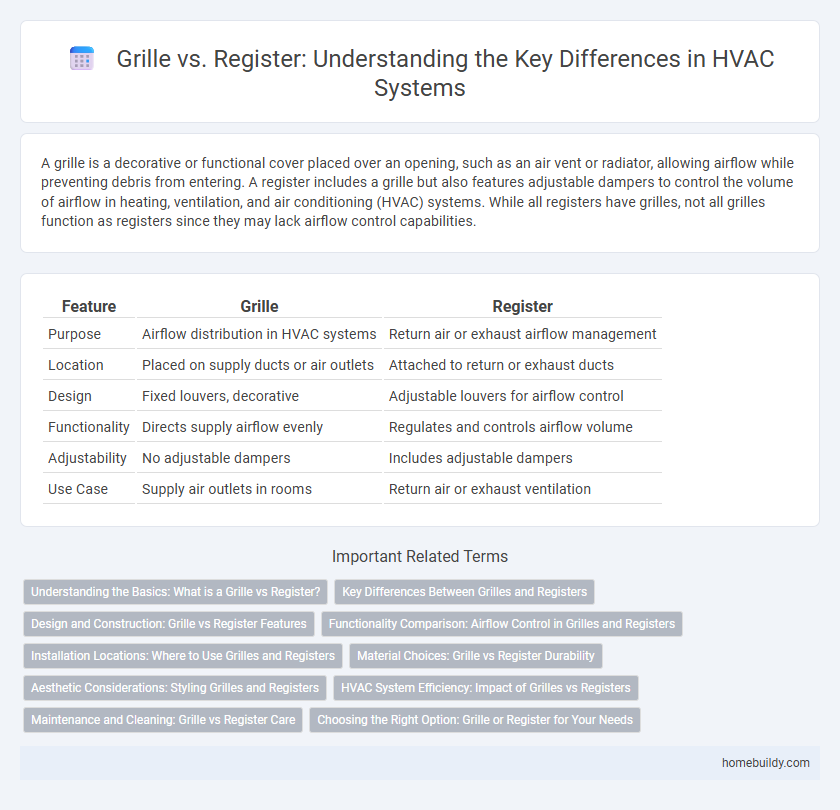
 A grille is a decorative or functional cover placed over an opening, such as an air vent or radiator, allowing airflow while preventing debris from entering. A register includes a grille but also features adjustable dampers to control the volume of airflow in heating, ventilation, and air conditioning (HVAC) systems. While all registers have grilles, not all grilles function as registers since they may lack airflow control capabilities.
Table of Comparison
| Feature | Grille | Register |
|---|---|---|
| Purpose | Airflow distribution in HVAC systems | Return air or exhaust airflow management |
| Location | Placed on supply ducts or air outlets | Attached to return or exhaust ducts |
| Design | Fixed louvers, decorative | Adjustable louvers for airflow control |
| Functionality | Directs supply airflow evenly | Regulates and controls airflow volume |
| Adjustability | No adjustable dampers | Includes adjustable dampers |
| Use Case | Supply air outlets in rooms | Return air or exhaust ventilation |
Understanding the Basics: What is a Grille vs Register?
A grille is a cover for an air vent that allows airflow while preventing debris from entering ductwork, often featuring fixed or adjustable slats. A register serves a similar function but includes a built-in damper to control airflow volume and direction within HVAC systems. Understanding the difference helps optimize ventilation efficiency and indoor air quality in heating and cooling applications.
Key Differences Between Grilles and Registers
Grilles primarily serve as aesthetic covers for air ducts, allowing air to flow freely into or out of a space without controlling airflow volume. Registers combine the grille with an adjustable damper, enabling users to regulate the amount of air passing through the duct. This key difference impacts HVAC system efficiency and room comfort by providing control only when using registers.
Design and Construction: Grille vs Register Features
Grilles feature an open, fixed-louver design that allows air to flow freely without the ability to control volume, making them ideal for return air or transfer air applications. Registers include adjustable dampers and movable louvers, offering precise airflow control, which suits supply air delivery and personalized comfort settings. Construction-wise, grilles are typically simpler, with robust frames for durability, whereas registers incorporate more complex mechanisms to facilitate airflow adjustment and direction.
Functionality Comparison: Airflow Control in Grilles and Registers
Grilles primarily function as decorative covers that allow air to pass freely between spaces while providing minimal control over airflow direction or volume. Registers combine grille features with adjustable dampers, enabling precise control of airflow to regulate temperature and ventilation more effectively in HVAC systems. The adjustable louvers in registers optimize air distribution, offering enhanced functionality compared to fixed grilles.
Installation Locations: Where to Use Grilles and Registers
Grilles are typically installed in exterior walls, doors, and return air ducts where airflow regulation is less critical, offering a protective barrier against debris and pests. Registers are commonly installed in floors, ceilings, or walls where precise airflow control is needed, often featuring adjustable dampers to regulate air volume. Selecting the appropriate placement depends on the HVAC system's design and the desired airflow management within the space.
Material Choices: Grille vs Register Durability
Grilles are typically made from sturdy materials such as aluminum, steel, or plastic composites, offering enhanced durability and resistance to wear and corrosion compared to registers, which often incorporate less robust materials like wood or thin metal with adjustable dampers. The metal construction of grilles ensures long-lasting performance in both indoor and outdoor HVAC applications, maintaining structural integrity under varying temperature and humidity conditions. In contrast, registers may require more frequent replacement or maintenance due to their sensitivity to environmental factors and mechanical components.
Aesthetic Considerations: Styling Grilles and Registers
Grilles and registers differ significantly in aesthetic design, with grilles often featuring decorative patterns and customizable finishes to enhance interior style. Registers prioritize functionality with adjustable dampers but can be designed to blend seamlessly into the decor using sleek, low-profile frames. Selecting between grilles and registers depends on balancing airflow efficiency with desired visual appeal in residential or commercial spaces.
HVAC System Efficiency: Impact of Grilles vs Registers
Grilles and registers play distinct roles in HVAC system efficiency, with grilles primarily serving as air return or supply covers without integrated dampers, allowing free airflow but less control over air distribution. Registers include adjustable dampers that enable precise airflow regulation, improving system balance and energy efficiency by directing air where it is needed most. Utilizing registers instead of grilles can reduce energy consumption and enhance HVAC performance by optimizing air distribution and minimizing pressure loss.
Maintenance and Cleaning: Grille vs Register Care
Grilles require less frequent cleaning due to their larger, more open design that resists dust buildup, while registers with dampers often need regular attention to ensure moving parts remain free of debris. Maintenance for grilles primarily involves wiping surfaces and occasional vacuuming, whereas registers demand careful cleaning to avoid damaging adjustable components. Proper care of either ventilation element enhances airflow efficiency and prolongs system lifespan.
Choosing the Right Option: Grille or Register for Your Needs
Grilles and registers serve distinct purposes in HVAC systems, with grilles primarily providing airflow return or supply without adjustable dampers, while registers include built-in dampers for controlling airflow. Choosing the right option depends on your need for airflow control; use grilles for fixed airflow applications and registers when you require adjustable ventilation. Proper selection ensures optimal air circulation, energy efficiency, and comfort within your space.
Grille vs Register Infographic