 homebuildy.com
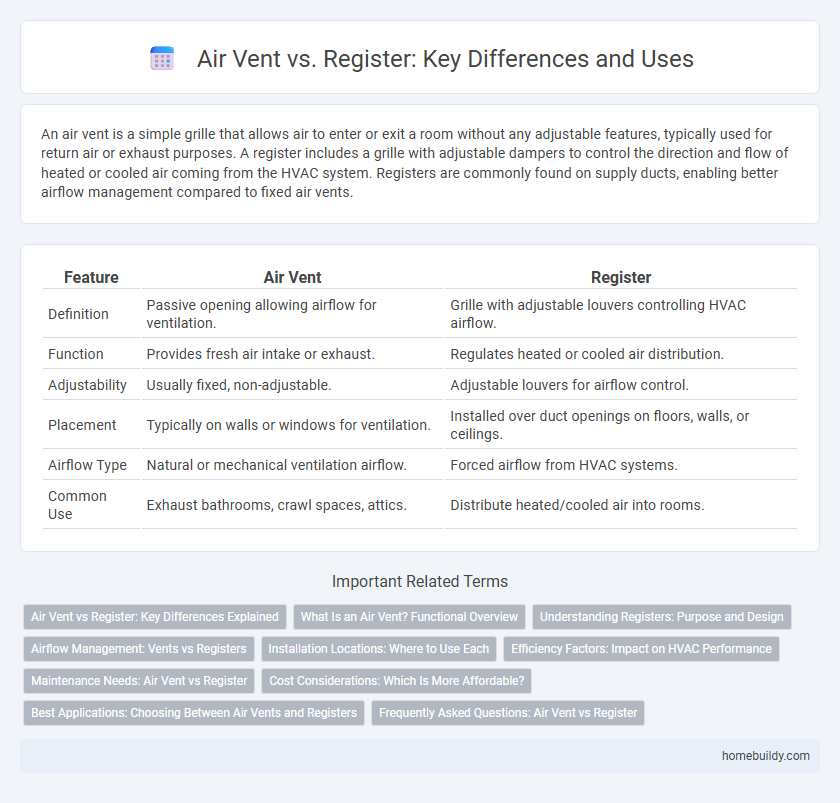
 An air vent is a simple grille that allows air to enter or exit a room without any adjustable features, typically used for return air or exhaust purposes. A register includes a grille with adjustable dampers to control the direction and flow of heated or cooled air coming from the HVAC system. Registers are commonly found on supply ducts, enabling better airflow management compared to fixed air vents.
Table of Comparison
| Feature | Air Vent | Register |
|---|---|---|
| Definition | Passive opening allowing airflow for ventilation. | Grille with adjustable louvers controlling HVAC airflow. |
| Function | Provides fresh air intake or exhaust. | Regulates heated or cooled air distribution. |
| Adjustability | Usually fixed, non-adjustable. | Adjustable louvers for airflow control. |
| Placement | Typically on walls or windows for ventilation. | Installed over duct openings on floors, walls, or ceilings. |
| Airflow Type | Natural or mechanical ventilation airflow. | Forced airflow from HVAC systems. |
| Common Use | Exhaust bathrooms, crawl spaces, attics. | Distribute heated/cooled air into rooms. |
Air Vent vs Register: Key Differences Explained
An air vent is a passive opening that allows air to flow in and out of a space for ventilation and airflow regulation, while a register combines an air vent with adjustable louvers to control the direction and volume of airflow. Air vents typically cover duct openings without any control mechanism, whereas registers provide customizable airflow control and usually include a damper for adjusting air passage. Understanding these differences helps in selecting the right component for efficient HVAC system performance and indoor air quality management.
What Is an Air Vent? Functional Overview
An air vent is a crucial component in HVAC systems designed to facilitate airflow by allowing air to enter or exit a room, ensuring proper ventilation and air circulation. Unlike registers, which include adjustable grilles and dampers to control airflow direction and volume, air vents typically function as passive openings that help maintain indoor air quality and thermal comfort. Proper placement and size of air vents directly impact ventilation efficiency and the overall effectiveness of heating, cooling, and air exchange processes.
Understanding Registers: Purpose and Design
Registers serve as adjustable air outlets in HVAC systems, allowing control over airflow direction and volume within a room. Unlike simple air vents that primarily facilitate air exchange, registers incorporate damper mechanisms to fine-tune ventilation efficiency. Their design typically includes a grille integrated with louvers, enhancing both airflow management and aesthetic appeal in residential and commercial settings.
Airflow Management: Vents vs Registers
Air vents and registers both play critical roles in airflow management within HVAC systems, but they differ in design and functionality. Air vents typically serve as passive outlets or inlets for air circulation without integrated dampers, allowing continuous airflow, whereas registers include adjustable dampers to regulate the volume and direction of air distribution. Effective airflow management often involves combining vents for consistent ventilation and registers for precise control, optimizing indoor air quality and thermal comfort.
Installation Locations: Where to Use Each
Air vents are typically installed in walls, ceilings, or floors to allow air to enter or exit a room, promoting proper ventilation and air circulation. Registers, equipped with adjustable grilles or dampers, are commonly placed on floors or walls to control airflow more precisely within HVAC systems. Choosing between an air vent and a register depends largely on the specific location and required airflow control, with vents suited for general air exchange and registers for adjustable air distribution.
Efficiency Factors: Impact on HVAC Performance
Air vents and registers differ significantly in their impact on HVAC performance, with registers featuring adjustable dampers that regulate airflow more efficiently compared to fixed air vents. Properly sized and positioned registers optimize air distribution, reducing energy consumption and enhancing system efficiency by maintaining balanced airflow throughout the space. In contrast, air vents without dampers can lead to uneven temperature control and increased strain on HVAC units, resulting in higher operational costs.
Maintenance Needs: Air Vent vs Register
Air vents typically require less frequent cleaning compared to registers because vents have smaller openings that trap less dust and debris. Registers, with adjustable dampers and larger slats, often accumulate more dust and need regular dusting and occasional vacuuming to maintain airflow efficiency. Proper maintenance of both components ensures optimal HVAC system performance and indoor air quality.
Cost Considerations: Which Is More Affordable?
Air vents generally offer a more affordable option compared to registers due to simpler design and lower production costs. Registers often come with adjustable louvers and decorative grilles, increasing their price and installation complexity. Choosing between an air vent and a register depends on budget constraints and aesthetic preferences within HVAC system planning.
Best Applications: Choosing Between Air Vents and Registers
Air vents are ideal for return air pathways and areas requiring subtle airflow, promoting efficient air circulation without disrupting room aesthetics. Registers, equipped with adjustable dampers, are best suited for supply air applications, allowing precise control of airflow and direction in living spaces. Selecting between air vents and registers depends on balancing airflow management needs with room design and functional requirements.
Frequently Asked Questions: Air Vent vs Register
An air vent, also known as a grille or diffuser, primarily allows air to flow into or out of a room from the HVAC system without control over airflow volume, whereas a register includes adjustable dampers to regulate that airflow. Frequently asked questions often highlight differences in terminology, functionality, and installation locations, with vents typically used for return air and registers for supply air. Understanding these distinctions helps homeowners select the right component for efficient heating, ventilation, and cooling performance.
Air vent vs Register Infographic